
Your weak side is holding you back: The importance of unilateral training
Dec 08, 2025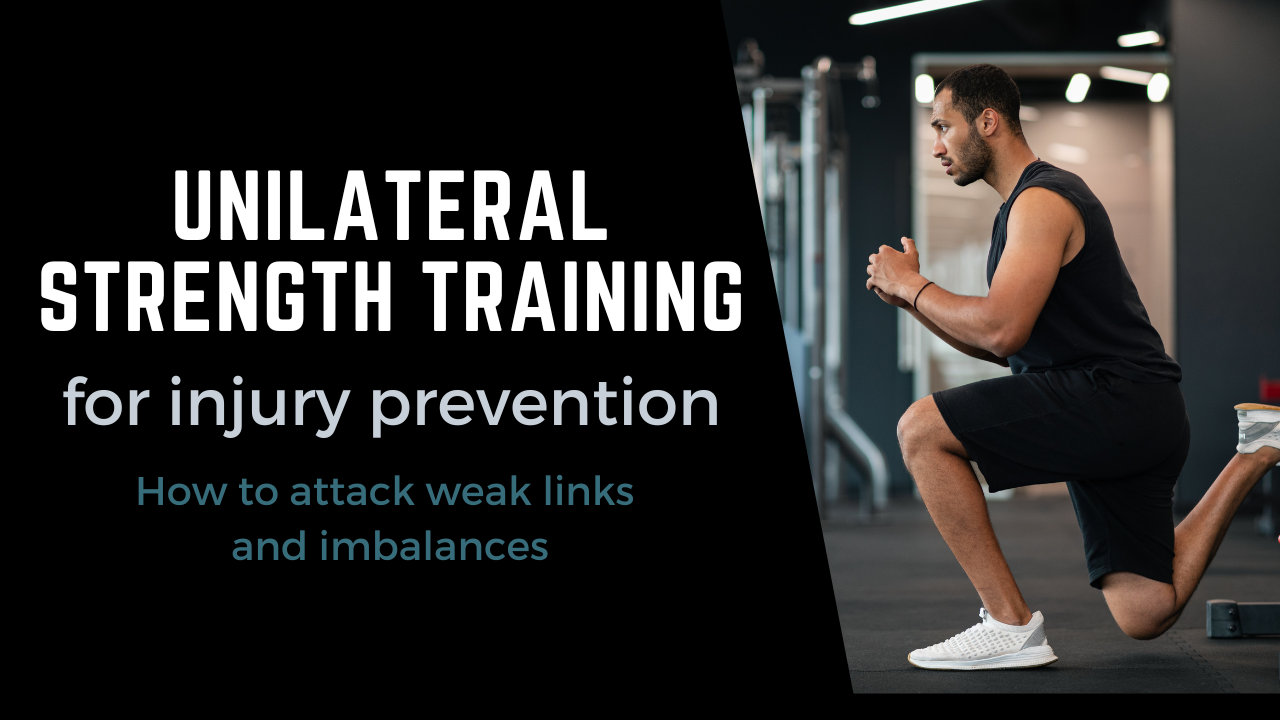
When most people think about strength training, they picture big lifts: squats, deadlifts, bench/overhead presses- the classic bilateral movements where both sides of the body work together. While these exercises are incredibly valuable, there is a critical piece of the injury-prevention puzzle that often gets overlooked: unilateral training.
Unilateral training involves working one limb at a time. Think split squats, step-ups, lunges, single-leg deadlifts, single-arm presses, and one-arm rows. These movements do far more than simply strengthen individual muscles, they help protect your body from the compensation patterns and imbalances that often lead to injury.
Here’s why unilateral training is a non-negotiable part in all of my rehab and fitness training programs.
Expose and attack weak links
Everyone has a dominant side. Over time, that dominance can create muscular imbalances: one glute firing better than the other, one shoulder more stable, one side of the core stronger. Bilateral exercises often mask these differences because the stronger limb subtly picks up the slack. The body is really good at compensating but when we remove one side of the body, options for compensation greatly reduce and we expose weakness and mobility deficits that were able to hide in bilateral movements.
By training each limb individually, you can:
-
Expose left–right strength and/or mobility discrepancies
-
Ensure each side is capable of absorbing and producing force independently
-
Address weaknesses before they turn into overuse injuries
- Improve motor control impairments
Balancing strength across the body creates a more resilient and symmetrical foundation which is key for preventing strain on joints and connective tissues.
Improve motor control and stability
Stability and motor control is key for injury prevention. When you’re on one leg or using one arm, your body has to work much harder to maintain balance and alignment. That means deeper activation of stabilizing muscles including:
-
Glute medius
-
Hip stabilizers
-
Scapular stabilizers
-
Core musculature
These muscles don’t just make you stronger—they help control movement under load, reducing the risk of overuse or poor mechanics that often lead to injury, especially during dynamic sports or heavy lifting.
Additionally, unilateral training helps improve communication between the brain and each side of the body. This communication is necessary for motor control and proprioreception which is our ability to control our own body position in space and then against external forces- both of which are necessary to reduce injury.
Improved core and pelvic stability
Unilateral training of both the upper and lower extremities demands strong anti-rotation and anti-lateral-flexion control. In other words: your core has to work to prevent your torso from twisting or leaning.
This enhances:
-
Lumbo-pelvic stability which is critical to mitigating low back pain
-
Hip alignment during movement which provides stability to the lower body
-
Transfer of force through the kinetic chain which increases our athletic capability and efficiency of movement
A stable pelvis and strong core aren’t just aesthetic goals—they’re essential for preventing low-back pain, improving gait mechanics, optimizing movement efficiency, and reducing the risk of hamstring, groin, and hip flexor injuries.
Reduces overuse stress on joints
Bilateral loading often involves heavier weights and greater compressive forces through the spine and extremities. While this type of training certainly has it's value, we also want to have options to load the body alternatively. This becomes particularly useful when navigating injury, returning to fitness after hiatus, training joint pain, or simply to manage volume and load in conjunction with heavy lifting
Unilateral training allows you to:
-
Use lighter loads while still challenging the muscles
-
Reduce joint stress
-
Strengthen stabilizers without heavy loads through the spine
For people recovering from injury—or anyone with a history of back, hip, or knee issues—unilateral movements create a safe path to regaining strength.
Application to life outside of the gym
As humans, we mostly function unilaterally both in our every day activities and in sport.
Most athletic actions are unilateral or staggered:
-
Running
-
Jumping
-
Kicking
-
Throwing
Even everyday tasks like walking, climbing stairs, and carrying groceries involve shifting body weight to one side.
Training unilaterally prepares your body for these real-world demands. It teaches the muscles and nervous system to coordinate effectively under asymmetrical loads which is exactly the kind of stress your body encounters outside the gym.
How I implement unilateral training into my rehab and fitness programs
Dependent on client goals, I program unilateral work either as a primary strength movement or as supplemental work after a heavy bilateral lift. There is no right or wrong answer, it depends on individual needs and goals for the session.
Some movements that I use frequently:
- Step-up variations
- Lunge variations
- Split squat variations
- Kickstand hinge/squat variations
- Single arm rows
- Single arm presses
- Unilaterally loaded core and spine exercises
Final thoughts
Unilateral training isn't just for rehab, it's extremely valuable in preventing injury and improving overall athleticism. Whether you are an elite athlete, someone with a physically demanding job, weekend warrior, or simply interested in training for longevity- you need to implement unilateral training into your regular fitness routine.
Looking for a training program to help you implement all of this? Check out my 12-Week Gym Program RESOLUTE.
RESOLUTE is your blueprint to move better, train with intention and stay resilient.
This program blends unilateral and multi-planar strength training, joint-health mobility work, and preventative rehab movements to help you move with confidence, power, and control.
It’s a strategically designed progression built to:
✅ Build real-world strength through single-side and multidirectional movements that correct imbalances and improve coordination
✅ Enhance joint integrity so your hips, shoulders, and spine stay healthy under load
✅ Prevent injuries before they happen with PT-informed mobility, stability, and corrective training
✅ Improve athleticism—balance, control, power, mobility—regardless of your sport or fitness level
For more info or to get started click HERE
As always, feel free to send me an email with any questions or topics you would like to learn about in future articles.
Yours in health,
-Jamie
